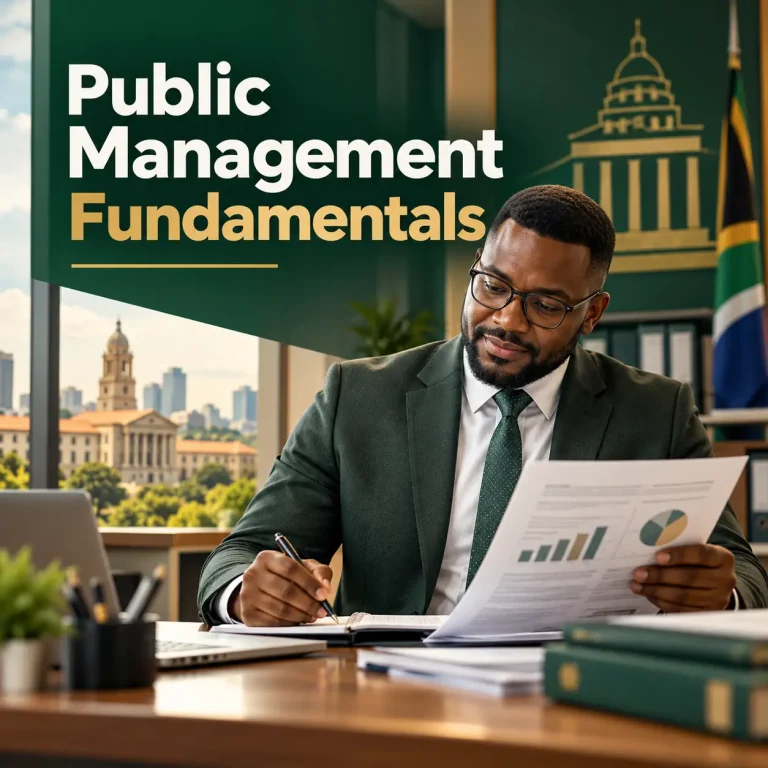
Study a Free Public Management Fundamentals in South Africa with Durban City Academy. The Free Public Management Fundamentals Course with Certificate in South Africa is an online beginner course for people who want to understand how government...
The Free Public Management Fundamentals Course with Certificate in South Africa is an online beginner course for people who want to understand how government institutions work and serve communities. Study public administration, ethics, policy, planning, finance and service delivery at your own pace, with a certificate available after completion.
It is suitable for South African learners exploring public service careers, entry-level government or municipal staff, and anyone who wants a clearer picture of how public institutions operate. You will study the responsibilities of different institutions and practise thinking through everyday management challenges, from community feedback to responsible use of public resources.
Public management applies management principles to organisations that serve the public. Unlike a private business, a public institution must work within its mandate, use authority responsibly and consider fairness and public value. This beginner course introduces those ideas in practical, accessible steps.
South Africa’s constitutional framework shapes how government is organised and how public administration should serve people. You will explore the national, provincial and local spheres, and consider how their responsibilities connect when communities need services.
Good public management also involves turning public priorities into plans that can be delivered and assessed. That means defining a problem, listening to affected people, considering realistic options and setting objectives that can be monitored.
In online learning, you can work through these fundamentals without needing previous experience in government. The examples are relevant to people interested in departments, municipalities and public entities, as well as those building general administrative and workplace skills.
Lessons cover integrity, public finance, service standards, teamwork and accountability. You will also consider how institutions can use feedback and performance information to recognise service gaps and make practical improvements.
The course connects day-to-day administration with broader responsibilities. For example, a service complaint may point to a communication issue, a resource constraint or a weakness in how work is coordinated.
As you study, you will build a vocabulary for discussing public institutions and their work. You will learn to distinguish roles, identify relevant management questions and consider what evidence could help guide an improvement.
On completion, you can use your certificate to record your learning as part of your continued development. You may also explore related subjects such as business administration and business communication.
The lessons move from core concepts to workplace application. Each one gives you a way to connect public management principles with the decisions and interactions that shape services.
Explore what public management means, how it differs from private management and why public value, fairness and responsible authority matter.
Learn about constitutional values in public administration and how national, provincial and local government relate to one another.
Consider the roles of departments, municipalities and public entities, and how mandates guide institutional responsibilities.
Examine professional conduct, impartial decision-making, conflicts of interest and ways to support a culture of integrity.
Follow the steps of defining a public problem, consulting affected people, assessing options and considering implementation needs.
Connect public priorities to plans, clear objectives, outputs, service standards and indicators that can track progress.
Understand how budgets support approved priorities and why financial responsibilities and procurement controls are important.
Explore accessible, responsive service and how community feedback or complaints can help identify areas needing attention.
Look at how staff capability, supervision, clear communication and coordination contribute to service quality.
Consider internal controls, reporting, oversight and how evidence can guide corrective action and sustained improvement.
A breakdown of the lessons covered in this course.
Public Management Fundamentals is designed for beginners who want a clear introduction to the subject, with practical lessons, guided learning, and simple explanations that are easy to follow online.
Yes, learners in South Africa can study this course online at their own pace, which makes it useful for flexible learning, personal development, and building practical knowledge from home or work.
This course covers practical learning areas such as What public management is and how it differs from private management, Public institutions, public services and the people they serve, Public value, fairness and the responsible use of authority, Constitutional values guiding public administration, helping learners build foundational knowledge that can be applied in study, work tasks, and everyday digital learning.
Most learners can work through the course in a few focused hours, but the online format allows you to move at your own pace and revisit lessons whenever you need extra practice.
A certificate is available after successful completion, which gives learners a simple way to show that they finished the course content and assessment requirements online.
These skills are useful because they support workplace readiness, digital confidence, and practical day-to-day tasks, which can help learners strengthen their knowledge in a South African learning and work environment.