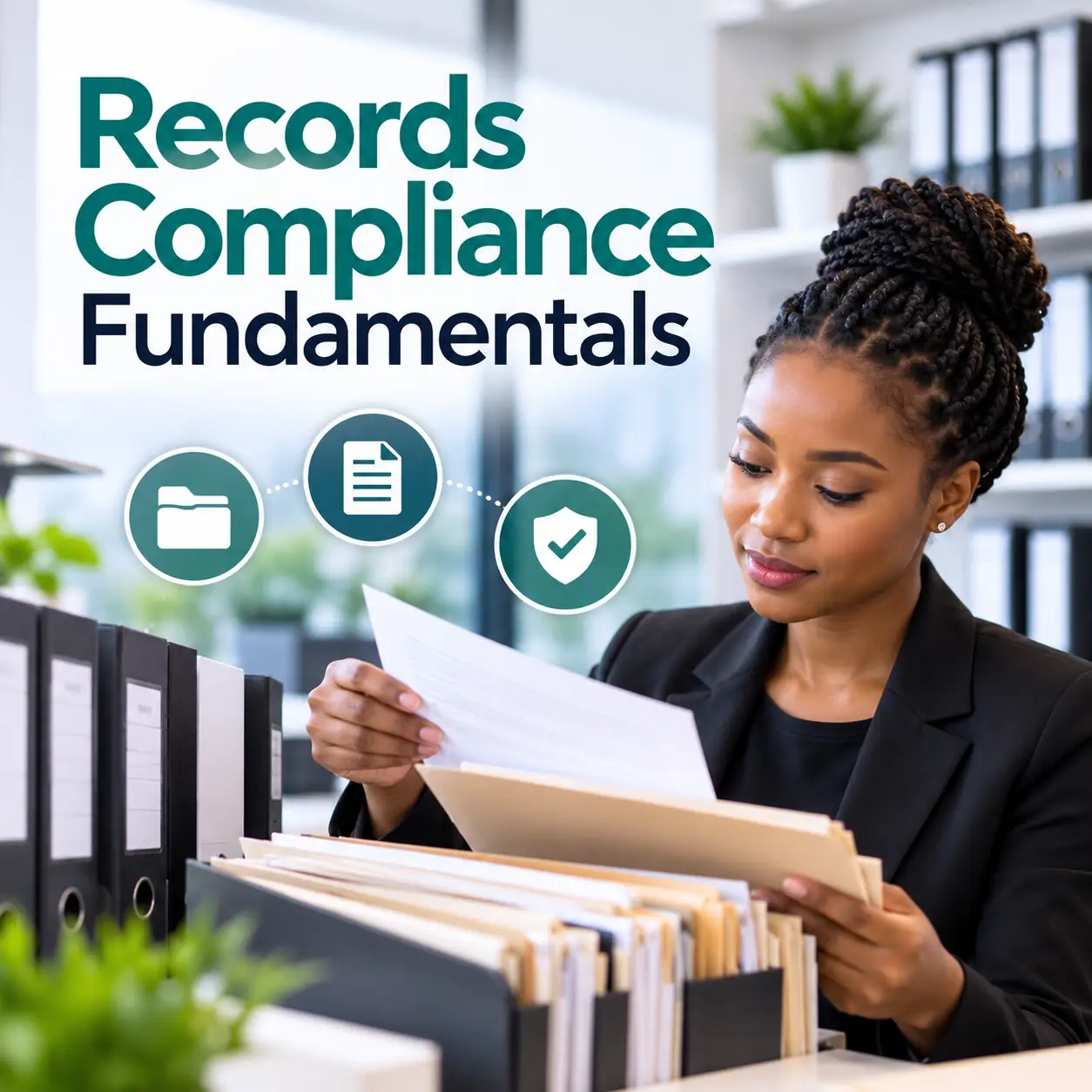
Study a Free Records Compliance Fundamentals Course with Certificate in South Africa with Durban City Academy. Learn what counts as a business record, why accurate.
10 lessons with topics and quizzes.
The Free Records Compliance Fundamentals Course with Certificate in South Africa is an online beginner course for people who want to handle workplace records more responsibly. Study how to create, organise, protect, retain and dispose of records, then receive a certificate upon completion.
It is suited to learners starting office work, administrative staff and anyone who handles documents or information as part of a job. Lessons cover recordkeeping duties, privacy, access controls, retention and practical ways to keep files accurate and retrievable.
Records are more than paperwork: they can show what happened, when it happened and how a decision was made. This beginner course introduces the habits and principles that help make records useful, dependable and appropriately protected.
In South African workplaces, records may contain personal information, business decisions or evidence of routine processes. Understanding how to handle them carefully can support accountable work and help staff follow the procedures set by their organisation.
You will explore how POPIA relates to the responsible handling of personal information, and how PAIA connects to requests for access to information. The course provides practical learning, not legal advice; learners should follow their organisation’s policies and consult appropriate guidance when needed.
Good records practice applies to paper files as well as electronic documents. Naming conventions, clear filing structures and sensible version control can make it easier to find the correct information and reduce confusion when files are shared.
The learning also follows records through their lifecycle: capture, active use, storage, archiving and final disposition. You will consider what details to record, how to correct errors transparently and why records should not be removed without authorisation.
Privacy and security are part of routine recordkeeping. You will look at recognising sensitive information, limiting access according to role and need, and taking care when transferring or sharing records.
Practical topics include classifying records, maintaining links between related files, checking for gaps and inconsistencies, and keeping digital records identifiable. These are useful foundations for office administration and information-handling tasks.
After completing the learning, you can use the course certificate to document your participation. For further reading, explore this guide to the records management compliance checklist and continue building your knowledge at your own pace.
Records compliance is relevant wherever people create, use or store workplace information. A missing document, unclear version or incorrectly shared file can make routine tasks harder and weaken confidence in the information available to a team.
This course gives you a structured introduction to records compliance without assuming previous experience. You can connect everyday tasks—such as naming a file or checking a form—with wider principles of accountability, privacy and controlled access.
For learners exploring office support, administration or records-related responsibilities, these foundations can help prepare you to follow workplace procedures more confidently. The course focuses on practical understanding rather than promising a particular job outcome.
Explore what counts as a business record and why accuracy, reliability and accountability matter. Learn the core principles that make records useful over time.
Consider how records duties connect with workplace procedures, privacy and requests for information. The lesson introduces POPIA and PAIA in a practical, general learning context.
Follow records from creation and capture through active use, storage, archiving and final disposition. See why each stage needs clear handling practices.
Learn to apply consistent naming and filing conventions, separate records by function or sensitivity, and maintain links between related documents.
Review the details that should be captured at the right time. Learn to check for accuracy and completeness and to manage corrections without obscuring the original record.
Study role-based access, protection for paper and electronic files, and safer ways to share or transfer information.
Recognise personal information in workplace records, consider what is necessary to collect and use, and reduce privacy risks during routine handling.
Explore approved retention schedules, storage and retrieval preparation, and authorised processes for disposing of records.
Learn how to keep electronic records identifiable and retrievable, manage changes and versions, and maintain dependable digital practices. For more background, see what electronic records are.
Build a habit of checking files for gaps and inconsistencies, preparing records for internal review and improving practices over time.
10 lessons with topics and quizzes covered in this course.
South African organisations work with information duties and internal processes that shape how records are created, accessed and retained. Learning the basics can help you recognise when privacy, information access or retention procedures may be relevant to a task.
The course also offers a flexible way to study records compliance online in South Africa. You can build foundational knowledge around familiar workplace examples, whether you are preparing for an administrative role or strengthening your current information-handling practice.
POPIA and PAIA have different purposes. Understanding that distinction can help you identify the right workplace route for a question or request. This practical overview of POPIA and PAIA at work offers additional context.
Records Compliance Fundamentals is designed for beginners who want a clear introduction to the subject, with practical lessons, guided learning, and simple explanations that are easy to follow online.
Yes, learners in South Africa can study this course online at their own pace, which makes it useful for flexible learning, personal development, and building practical knowledge from home or work.
This course covers practical learning areas such as What counts as a business record, Why accurate records matter to accountability, Core principles of reliable recordkeeping, How records duties connect to workplace procedures, helping learners build foundational knowledge that can be applied in study, work tasks, and everyday digital learning.
Most learners can work through the course in a few focused hours, but the online format allows you to move at your own pace and revisit lessons whenever you need extra practice.
A certificate is available after successful completion, which gives learners a simple way to show that they finished the course content and assessment requirements online.
These skills are useful because they support workplace readiness, digital confidence, and practical day-to-day tasks, which can help learners strengthen their knowledge in a South African learning and work environment.