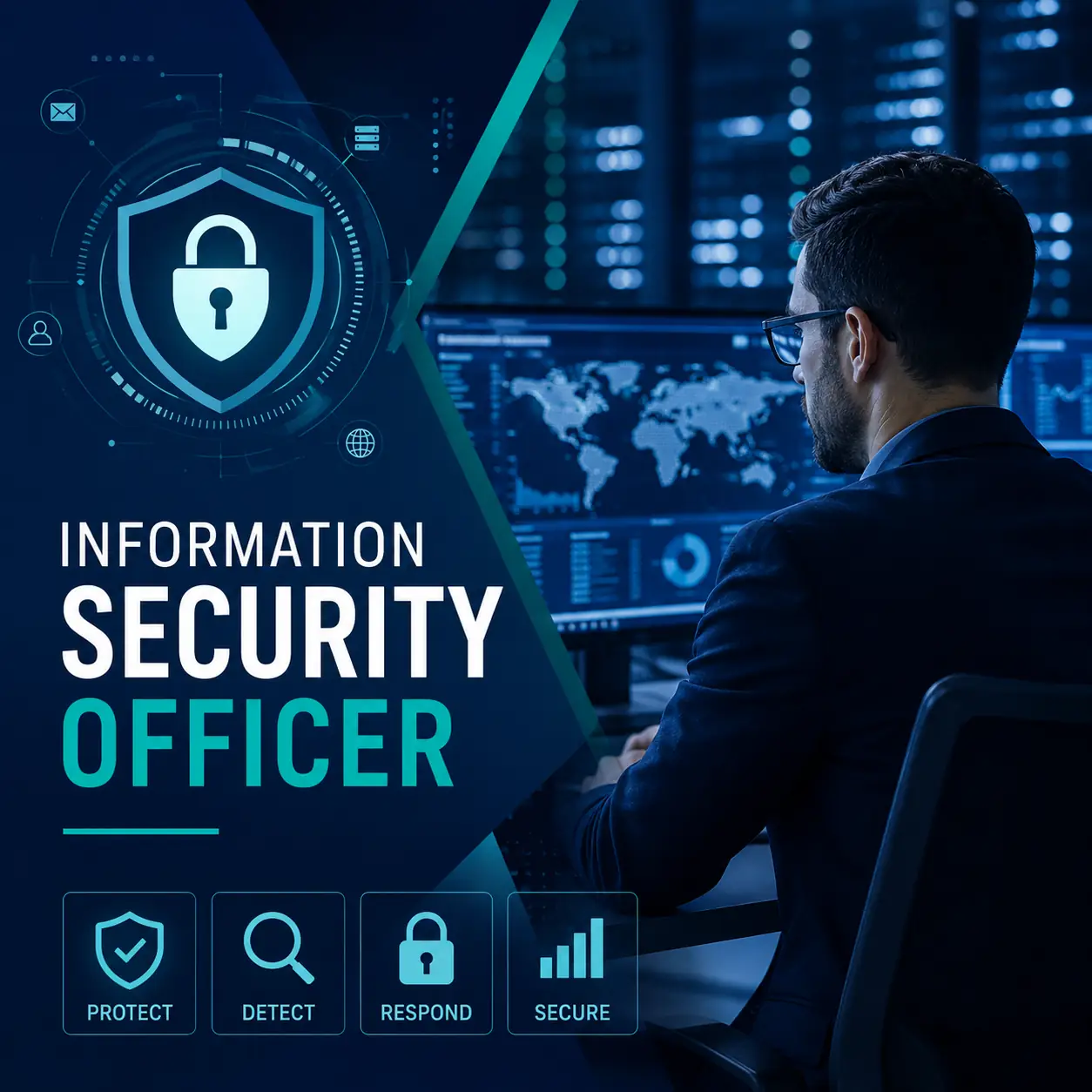
Study a Free Information Security Officer Course with Certificate in South Africa with Durban City Academy. Learn definition and importance of information security,.
10 lessons with topics and quizzes.
This course covers ten detailed modules that balance theoretical knowledge with real-world workplace integration. You will come away with actionable skills and a clear understanding of how security principles apply on a day-to-day basis.
After you finish, your certificate will confirm your competency in the fundamental areas of information security officer responsibilities. You can also explore related guides and courses to deepen your knowledge and advance your cybersecurity journey.
Information security is a critical field in South Africa’s digital economy, especially given rising cybercrime rates and stricter data protection laws. Skilled information security officers are essential to help organisations protect their assets, reduce risk exposure, and maintain trust with clients and partners.
This course offers practical knowledge that is relevant to various industries, including finance, government, healthcare, and more. Learning these skills can enhance your career prospects in an expanding job market for cybersecurity roles.
Through this course, you gain an understanding of how to implement security frameworks and policies tailored to South African legal requirements, such as the Protection of Personal Information Act (POPIA). Such know-how is crucial for organisations to avoid data breaches and legal penalties.
Get familiar with basic concepts and why information security matters today.
Explore key frameworks like ISO 27001 and NIST, along with South Africa’s regulatory context.
Learn how to identify, evaluate, and control risks within organisational systems.
Understand common cyber threats and learn how to detect and address system weaknesses.
Discover how to develop, implement, and enforce security rules and guidelines.
Study methods to secure access and verify identities effectively.
Identify what constitutes an incident and how to manage its lifecycle.
Understand principles of data privacy and compliance with POPIA.
Learn about firewalls, antivirus software, and encryption techniques used to secure systems.
See how to apply your knowledge in daily workplace scenarios for continuous security improvement.
10 lessons with topics and quizzes covered in this course.
Upon completion of all lessons and assessments, you will receive a certificate from Durban City Academy to confirm your achievement. This certificate demonstrates your understanding of essential information security officer skills and can enhance your CV or professional profile.
The certificate is issued safely online and is downloadable immediately—no additional fees apply. It serves as evidence of your successful learning in this free beginner course available to South African learners.
Information Security Officer is designed for beginners who want a clear introduction to the subject, with practical lessons, guided learning, and simple explanations that are easy to follow online.
Yes, learners in South Africa can study this course online at their own pace, which makes it useful for flexible learning, personal development, and building practical knowledge from home or work.
This course covers practical learning areas such as Definition and importance of information security, Key roles and responsibilities of an information security officer, Overview of South African cybersecurity landscape, Introduction to common security frameworks (ISO 27001, NIST), helping learners build foundational knowledge that can be applied in study, work tasks, and everyday digital learning.
Most learners can work through the course in a few focused hours, but the online format allows you to move at your own pace and revisit lessons whenever you need extra practice.
A certificate is available after successful completion, which gives learners a simple way to show that they finished the course content and assessment requirements online.
These skills are useful because they support workplace readiness, digital confidence, and practical day-to-day tasks, which can help learners strengthen their knowledge in a South African learning and work environment.